
Super-efficient cooling: without trained technicians, there are no energy savings
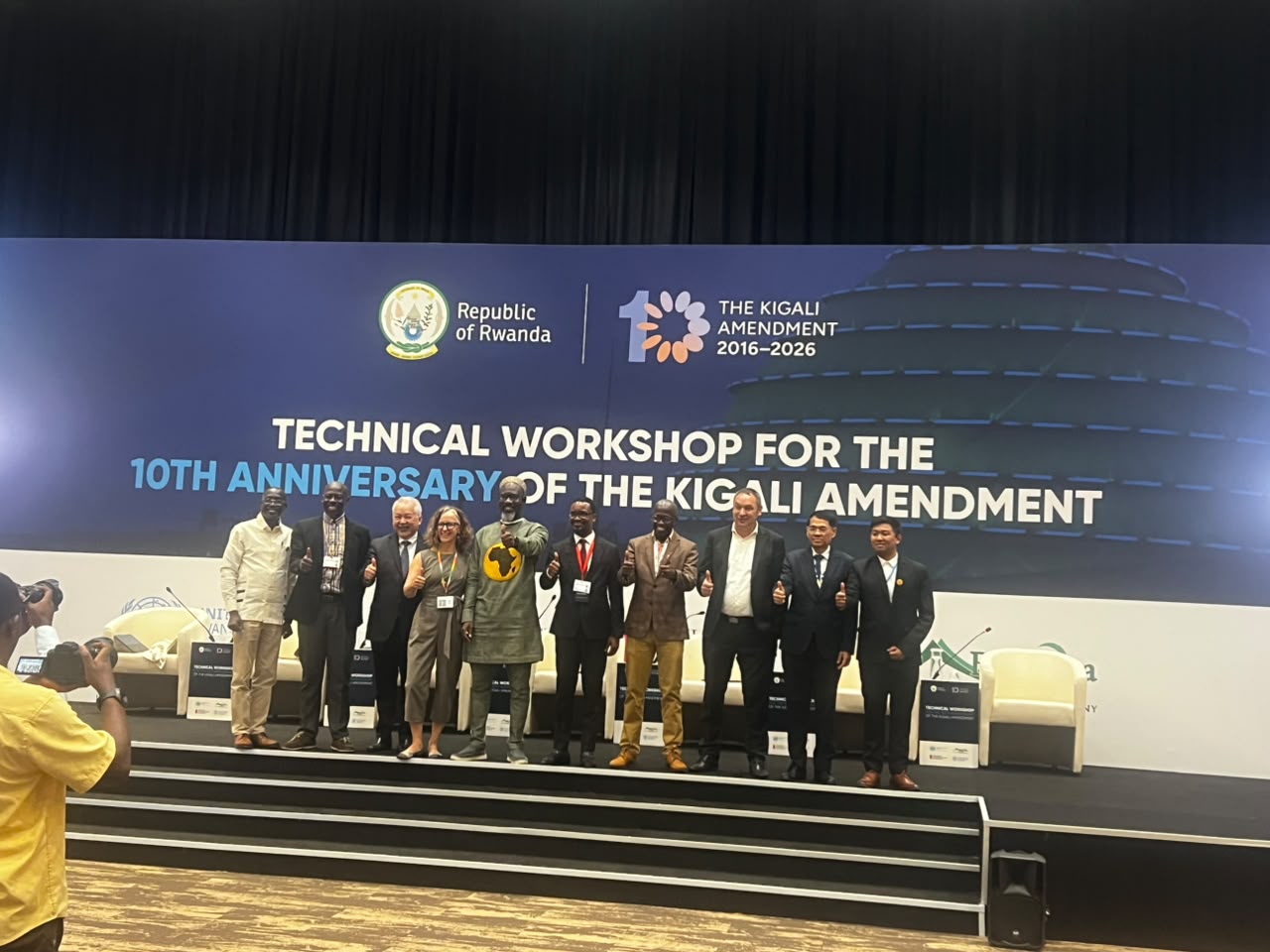
Reducing HFCs is not enough: over the lifetime of equipment, the electricity consumed often weighs more heavily on the climate balance than refrigerant leaks. At the Technical workshop for the 10th anniversary of the Kigali Amendment, Sunday 1 November at the Kigali Convention Centre, Madi Sakandé, President of U-3ARC and representative of the New Cold Akademy, was invited to address a decisive question: what skills will African technicians need for super-efficient technologies to deliver on their promises? Basile Seburikoko, Secretary for Communication and External Relations, actively took part in the event alongside him.
Kigali, Rwanda, 1 November 2026.
Why does energy efficiency matter as much as refrigerants?
Organised by the Rwandan government for the tenth anniversary of the Kigali Amendment, the workshop devoted its Session 3 to energy efficiency. It was co-facilitated by Obed Baloyi (South Africa) and Ana Maria Kleymeyer (CCAC).
Its starting point: in many cooling systems, the electricity consumption over the equipment's lifetime generates more emissions than refrigerant leaks. According to the elements presented, compliance with the Amendment alone would avoid 1.1 billion tonnes of CO₂ equivalent by 2050. Energy efficiency gains could add a further 2.2 billion tonnes.
A panel of institutions, a voice from the field
Around the table: Cambodia, with Pak Sokharavuth; Ghana, with Kofi A. Agyarko, on minimum performance standards and labelling; Philipp Denzinger (GIZ Proklima); Yomi Banjo (UNIDO); Mzwandile Thwala (U4E); Thanavat Junchaya (World Bank), on financing. Madi Sakandé represented U-3ARC but also the New Cold Akademy.
This is the place of the Union of African Associations of Refrigeration and Air Conditioning Actors: to remind that these pieces of equipment are installed, adjusted and repaired by professionals whose skills directly affect the results.
Madi Sakandé: four questions, one common thread
The President was invited to address "future opportunities for super-efficient cooling technologies" from four angles:
- West African markets: which technologies offer the most opportunities in the next ten years, and what is holding them back?
- The Sahel: what role for solar and off-grid cooling, particularly for cold storage and health facilities, in a region with high temperatures and unreliable grids?
- Skills: what will African technicians need, and how is the New Cold Akademy helping to build them? Super-efficient equipment only delivers on its promises if it is properly installed and maintained.
- African businesses and the diaspora: how can these technologies be brought to local markets at an affordable price
Standards, financing, technicians: the three challenges
Standards. Minimum energy performance standards (MEPS) cover 89% of global air conditioning energy consumption, compared with around 50% in Africa. Without an adapted framework, inefficient equipment continues to arrive on African markets.
Financing. High-performance equipment costs more to purchase. The Multilateral Fund has opened several financing windows, including one of $100 million for manufacturers (15 projects) and one of $20 million (69 projects). Two projects were approved in June 2026 for $42.8 million, through a revolving fund. The challenge remains to ensure that these resources reach the SMEs and technicians of the continent.
Technicians. They are the last link in the chain and often the only ones who actually touch the equipment. The facilitators also raised four cross-cutting questions: how to integrate efficiency gains into national contributions (NDCs), manage the rise in electricity demand, make efficiency a pillar even though it is not binding under the Amendment, and strengthen cooperation between ozone, energy and standards authorities.
What U-3ARC takes away: skills first
The session recalled that high-performance technology only produces its effects in the hands of trained people, and at an accessible price. For U-3ARC, this translates into two priorities: training and certifying local technicians, and ensuring that international financing reaches those who install and maintain the equipment. A poorly installed super-efficient piece of equipment saves nothing.