
Said El Harch delivers the workshop’s overall conclusions and puts SMEs at the heart of the next decade
The Vice-President of U-3ARC, Said El Harch was entrusted with the general conclusions of the entire Technical workshop for the 10th anniversary of the Kigali Amendment in Kigali. After leading Session 2, on supporting SMEs during technology transitions, he took stock of ten years of implementing the Kigali Amendment: a transition that is moving, energy efficiency that must be integrated, and small and medium-sized enterprises that need tools and training so change actually happens on the ground.
Kigali, Rwanda, 1 November 2026.
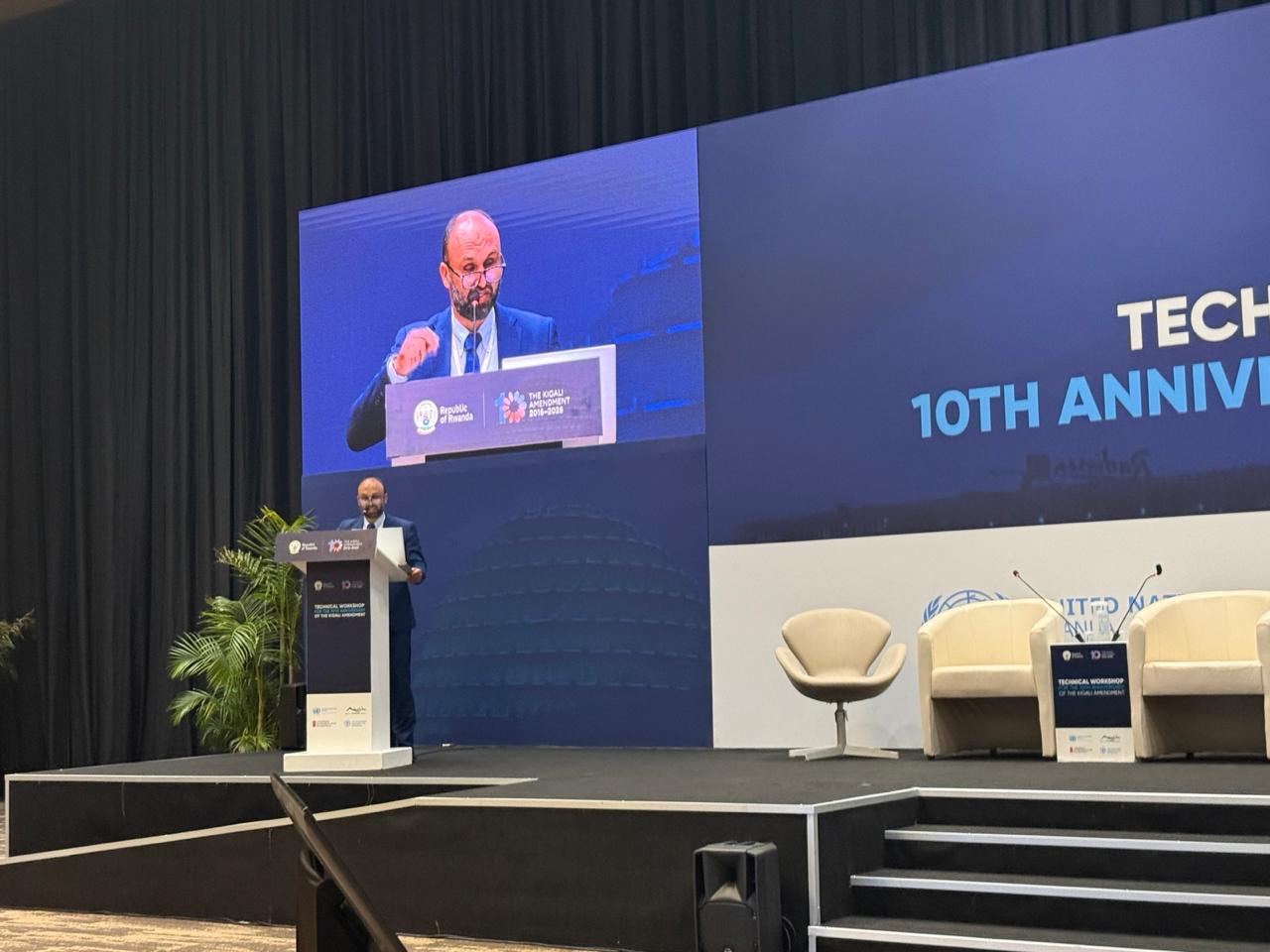
A synthesis entrusted to an African voice
It is rare for a representative of an African professional organisation to be asked to conclude a workshop attended by Parties, implementing agencies and financial institutions. Yet that is the task that fell to Said El Harch, Vice-President of the Union of Associations of African Actors in Refrigeration and Air Conditioning (U-3ARC), at the end of a day organised for the tenth anniversary of the Kigali Amendment. The Union’s President, Madi Sakandé, was a panellist in Session 3, on energy efficiency.
His speech opened with a blunt question: “Ten years ago, in this very city, the world made a promise. Today we spent a day asking ourselves honestly: how are we keeping it?”
Session 2: supporting SMEs during technology transitions
Mr El Harch was not speaking as a mere observer. He had led Session 2, titled “Supporting SMEs during technology transitions”. It ran in parallel with Session 3, on energy efficiency, where the Union’s President, Madi Sakandé, took part as a panellist. U-3ARC was thus present in both rooms.
The theme held a central place in his conclusions, in line with the reality of the Union’s member associations, which bring together precisely these field professionals.
Six sessions, one thread: from paper to practice
The Vice-President recalled that over six sessions, participants had followed the full arc of implementation. They examined how the HFC phase-down is moving in both Article 5 and non-Article 5 parties. They looked at what the transition of refrigeration, air-conditioning and heat pumps to low- and zero-GWP alternatives demands in practice: technology choices, flammability and toxicity safety, and the standards and training that make safe deployment possible.
What gave him “real hope,” he said, were concrete examples: policies that moved from paper to practice, factory floors that changed technology, and technicians who learned new skills over ten years.
Energy efficiency: not giving away the climate gain
On energy efficiency, the day’s message was, in his words, clear. A phase-down that cuts refrigerant GWP but leaves equipment inefficient gives away part of its climate benefit. Integrating HFC measures with minimum energy performance standards, and with wider sustainable cooling strategies, is how to capture the full gain for ozone, climate and development.
SMEs: where the transition actually happens
The longest passage of the speech covered lifecycle refrigerant management: servicing practices, recovery, recycling, reclamation, tracking and end-of-life handling. All of it, he stressed, depends on small and medium-sized enterprises: servicing workshops, local installers, recyclers and small manufacturers. They sit closest to the equipment and the customer and, in many countries, they are where the transition really happens.
Properly integrated, they become a source of skills, jobs and local enterprise. That requires four things: access to affordable finance, practical training and certification, tools and recovery equipment within reach, and simple, clear regulation. These points echo the work of U-3ARC, whose member associations bring together precisely these professionals.
A shared responsibility
The different rooms showed, according to Mr El Harch, that the way forward is shared. Parties, industry, academia, the Multilateral Fund and implementing agencies all have an integral role to play over the next decade and beyond.
He thanked the Government and people of Rwanda, the Ozone Secretariat, the panellists, co-facilitators and rapporteurs, and the workshop’s partners: One UN, CIFF, the Clean Climate Collaborative and FAO.
Towards MOP38
He closed by urging participants to carry the spirit of the day into MOP38, which opens right after in Kigali, along with the case studies and the conviction that the next decade can deliver even more than the first. For U-3ARC, this role as the workshop’s closing voice confirms that the voice of Africa’s cooling professionals counts in this debate.